
TIP 9 – Context is Everything


Context Is King: How One Line of Explanation Can Save Your Next Big Decision
Context turns charts from pretty pictures into decisions people can trust. Without it, even accurate numbers can mislead, trigger overreactions, or create false confidence.
Simple story:
The room fell quiet as the slide hit the screen. A sharp spike towered over the previous quarters, a record profit in Q4. Phones came out, photos were taken, and someone joked about finally upgrading the office coffee. Budget owners began to mentally spend the spike.
They started before the CFO had even finished the sentence. “As you can see, we had a fantastic finish to the year.” A few minutes later, she added a noteworthy detail. Almost as an aside, she remarked, “Most of this jump is from a one-time asset sale.” You could feel the energy drain.
The chart hadn’t changed. Only the context had, and suddenly, the story looked very different.
This is from the series of TOP 30 Tips in Data Storytelling.
“Context is the frame that quietly tells your audience what the picture is really about.”
One Chart, Two Stories: How Adding Context Turns Misleading Metrics into Trusted Insight
Context is everything. Data without context can be technically correct and still deeply misleading. When you don’t specify where the numbers come from, people fill the gaps with their own assumptions. They also do this when you don’t mention what period they cover or which one-off events shape them.
Context is what turns numbers into knowledge. It tells your audience how to read a result. It also indicates how much weight to give it, and what to do next. In finance, M&A, and sales, that difference is crucial.
It separates sound decisions from expensive missteps. It also distinguishes a team that trusts your charts from one that quietly ignores them.
Example: Finance (FP&A)

Rough Situation: Quarterly Profitability
How not to do it:
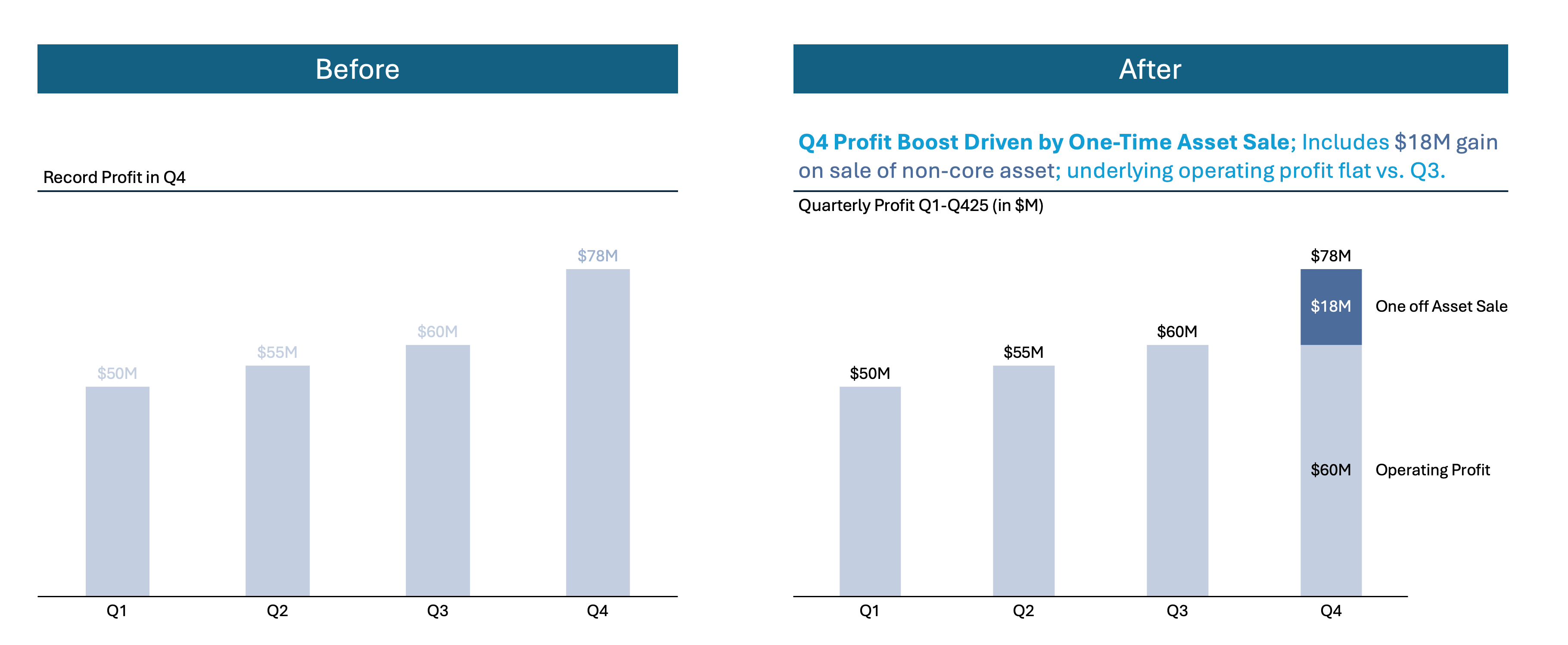
A CFO presents a slide showing quarterly profit with a big spike in Q4. The chart is clean, and the title reads “Record Profit in Q4.” There is no note that the company sold a non‑core asset in that quarter, adding a one‑time gain.
On its own, the visual leads leaders to conclude that operations have dramatically improved. Managers may start planning higher spending or bonuses. They believe the business has turned a corner. However, in reality, underlying margins are flat. This is exactly the risk of isolated financial visuals without explanations of underlying drivers and unusual items.
How to do it:
The same chart is shown, but the CFO adds crucial context:
Title: “Q4 Profit Boost Driven by One‑Time Asset Sale.”
Subtitle or annotation: “Includes 18M gain on sale of non‑core asset; underlying operating profit flat vs Q3.”
Time frame: “Q1–Q4 2025, reported in USD.”
In one sentence, the slide distinguishes recurring operations from one‑off events and explains how to interpret the spike. Leaders now understand that this is not a new baseline and will avoid overcommitting future costs based on temporary profit. The chart is the same, but the context has turned it into an honest view of performance.
When most people hear “add context,” they think “add more text.” That’s not the goal. The goal is to provide just enough background. This ensures your audience reads the number the way you intend. It prevents them from reading it based on their assumptions. Think of context as the frame around a picture. It doesn’t change the image. But it changes what people see in it.
A helpful way to think about context is in three layers: data context, business context, and audience context. If you cover these three, your charts and metrics become much harder to misread.
First, the DATA Context.
Data context makes the metric unambiguous. It answers “what, when, and how measured,” so no one has to guess.
Focus on:
Time frame: Is this “last month,” “YTD 2026,” “last 12 months,” or “Q4 2025 vs Q4 2024”?
Scope and definition: Does “revenue” exclude FX, refunds, or one‑offs? Is “EBITDA” before or after restructuring?
Method: Is it actuals, forecast, run‑rate, or annualized? Is the multiple based on trailing or forward earnings?
A simple mini‑framework you can apply: WTS
What metric is this (precise definition)?
Time period covered?
Special treatments or one‑offs?
For example, instead of “Profit,” write: “Q4 2025 reported profit, including $18M one‑time gain on asset sale.” That one line of data context prevents a lot of wishful thinking.
Example: Sales

Rough Situation: Revenue decline of 20% Month over Month
How not to do it:
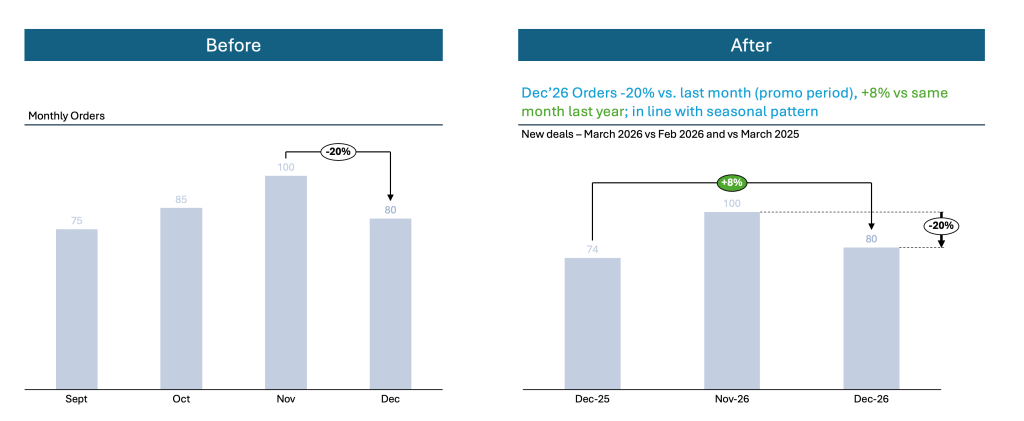
A sales dashboard highlights a KPI card: “New deals this month: 80 (‑20% vs last month).” This is shown without any mention of seasonality or the chosen comparison period.
Sales leadership sees the red “‑20%” and immediately worries about performance. They push for emergency actions. Last month was an unusually strong period due to an annual promotion and quarter‑end rush. Compared to that, one month alone is misleading.
How to do it:
The updated dashboard keeps the same metric but adds context in two simple ways:
Time frame: “New deals – March 2026 vs Feb 2026 and vs March 2025.”
Supporting text or visual: “‑20% vs last month (promo period), +8% vs same month last year; in line with seasonal pattern.”
With this frame, the “drop” is reframed as normal seasonality with year‑on‑year improvement. Managers can focus on structural issues (e.g., win rate, pipeline quality) instead of reacting emotionally to a misleading month‑over‑month comparison.
Context shifts attention to trends and appropriate benchmarks instead of raw deltas.
Second, the BUSINESS Context.
Business context explains why this number matters in the real world. It connects the metric to benchmarks, drivers, and decisions.
Focus on:
Benchmarks: Is this good or bad relative to target, last year, peers, or guidance?
Drivers: Which main factors pushed this up or down (pricing, volume, FX, promotion, outage)?
One‑time vs structural: Is this a sustainable change or a temporary blip?
You can use a simple question to check the business context:
“If someone sees this number alone, could they mistake a temporary bump for a structural change, or vice versa?”
If yes, add one short line that anchors it, e.g. “18 x EBITDA reflects higher growth and margin vs peers (sector median 12 x on trailing EBITDA)” or “‑20% vs last month, but +8% vs same month last year; normal seasonal pattern.“
Finally, the AUDIENCE Context.
Audience context is about relevance. The same chart needs different framing for the board, an M&A committee, or frontline sales managers.
Focus on:
Their decision: What are they trying to decide with this chart—approve a deal, adjust quota, cut costs?
Their blind spots: What assumptions do they bring that might lead them to misread the number?
Their level: Do they need detail (e.g., FP&A team) or just the core risk/opportunity (e.g., CEO)?
A quick audience context check:
“What question is this audience really asking, and does my title + annotation answer that?”
For example, a board slide might say: “Q4 Profit Spike Is One‑Time; Underlying Margin Flat,” whereas an FP&A slide might add detail on which cost lines and gains drive that outcome. The data is the same; the context is tuned to the audience’s decisions.
Summary – From insights to action
Data without context is like a quote without its paragraph: technically correct, but dangerously easy to misread. A profit spike, a high multiple, or a sales dip can all be misleading. This happens when you strip away time frame, drivers, and one-off events.
When you build context in, you define where the data comes from. You identify which period it covers. You understand what assumptions and exceptions apply. By doing this, you turn raw numbers into responsible insight. You earn trust from your CFO, deal committee, and sales leaders.
For your next report or dashboard, pick one key chart. Upgrade its context. Add the time period to the title. Highlight any one-time effects. Replace a neutral label with an insight-first headline. If someone can now interpret the result correctly without you in the room, you’ve done your job. Start small: one chart, one sentence of context, one better decision.
For free resources to help you on your Data Storytelling Journey, click here.
Don’t forget to try the free 10 Step Training for Curious Beginner here.
To keep Transforming Your Data Storytelling Journey, sign up for regular Insights.
Context.
So important.
It happens in data.
It happens with people and news, with certain judgments without knowing the context and background.